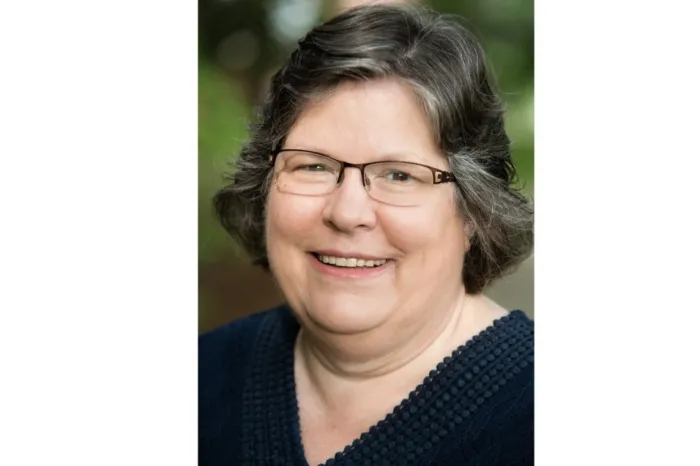
As alumni, colleagues, students and friends filed into Thomas Hall 124 on Friday, Oct. 16, there was a tangible sense of excitement and expectation in the air, but also an unmistakable sadness as Dr. Beverly Hogue prepared to take the podium for what would be her last public lecture at Marietta College. The audience had gathered in anticipation to hear Hogue deliver what others affectionately deemed her “Best Lecture.”
Beginning with a picture of the poet, Robinson Jeffers’ Hawk Tower in Carmel, California, Hogue explained that Jeffers built this tower by hand, putting each stone in place for his wife, Una, and their sons, but once it was completed, the tower became much more of a treasured writer’s retreat for himself. Hogue had previously toured this site with a group of students in her California poetry class. With characteristic humor and wit, Hogue joked about the narrowness of the tower’s turret, remembering that there was hardly enough room for everyone to stand, and that from the top, they could all clearly see into a neighbor’s window. This picture of a poet’s physical creation, paired with more literary, creative ones, formed the cornerstone of Hogue’s theme for the day: “Words and Stones.” This concept is central to each of the works she would discuss but also a reminder of what teachers of literature hope to do, even when it doesn’t seem possible.
Before coming to Marietta, Hogue worked as a journalist in northwest Ohio while finishing her Ph.D. at Bowling Green State University. She joined Marietta College’s faculty as a non-tenure-track professor and interim Writing Center director in 2000. She went on to achieve tenure and serve as chair of the faculty council and the English department. Hogue also served as director of the Worthington Center for Teaching Excellence from 2009 to 2012, and again in 2023. In 2012, Hogue was awarded the prestigious John G. and Jeanne B. McCoy Teaching Excellence Professorship. During her impressive 26-year tenure at Marietta, Hogue has dedicated countless hours to the students and programs that make the College uniquely successful. She has taught many different courses and helped many English students reach graduation and find success beyond Marietta. She has taught everything from classes on nature and African American literature to capstone courses on humor, and through it all, Hogue will tell you, it is the students who have kept her going for all these years.
“Every year there's a new crop of students challenging me to make old material new again and develop new ways to help them learn,” Hogue said.
That perspective helped shape Hogue’s decision about the topic of her final lecture. Not long ago, she had a conversation with a community member who questioned why anyone should still study literature. Always aware of the “massive amount of energy it takes to engage students in learning,” Hogue knew she wanted to address that idea and impress upon her audience why and how literature still matters.
Beginning with Jeffers’ poem “To the Stone-Cutters,” Hogue examined the idea that the poet was often misunderstood as a misanthrope when his work reveals something more nuanced about the human condition. She invited the audience to consider the line “Man will be blotted out,” focusing not on the line itself but on the significance of the next word: “yet.” That nuanced moment of hope suggests that words, like structures and stones, can endure long after we are gone, much like Jeffers’ own tower.
She next turned to Raymond Carver’s short story “Cathedral,” in which a man struggles to describe a cathedral to his wife’s blind friend, Robert. When the two draw a cathedral together, the narrator experiences an epiphany that begins to disrupt his isolation and tightly held prejudices. Through Robert’s words and their human connection, the narrator begins, perhaps for the first time, to truly “see.”
Finally, Hogue turned to “Persimmons” by Li-Young Lee, in which the speaker recalls being punished by his sixth-grade teacher for mistakenly pronouncing “persimmon” as “precision.” He recounts other words he confused, including “wren” and “yarn” and “fight” and “fright.” But these “mistakes,” Hogue emphasized, carry meaning, connecting the speaker to his heritage, memories and identity. His understanding of persimmons and reflections on his blind father further reveal how language can connect memory, identity and the immigrant experience.
Together, the three works illustrated Hogue’s central point: Literature can challenge assumptions, connect people to memory and identity, and build something that endures.
Hogue then asked the audience to recite together the significant lines from “To the Stone-Cutters” once more:
“Yet stones have stood for a thousand years.”
With everyone reading aloud, the theme came full circle.
“Literature allows humanity to build things that matter, whether they're stone walls or poems or cathedrals or cultural institutions,” Hogue said.
Hogue has built a lasting legacy of her own at Marietta. One does not have to search long to find students who are ready to openly praise Hogue’s teaching style.
Current student Jillian Couts said, “I can confidently say that she has been a source of inspiration, not only for me, but for the entire department.”
Former students Stephanie Ogden and Elizabeth Stern also feel the impact of Hogue’s unique style of teaching and wisdom.
“I didn’t realize during my years as a student how much I was truly learning from her — not just about literature, but about what it means to be a good teacher,” Ogden said.
Stern agreed. “Her knowledge of American literature is impressive, and she does a phenomenal job of imparting it to students,” she said. “She will be missed for her teaching skills and the sense of community she brought to the program.”
Hogue’s style and unique approach were not lost on those who attended her final lecture. Reflecting on the day, Hogue summed it up herself.
“I was eager to share some literature that never fails to inspire me, and I hoped that listeners would walk away with a desire to read more literature, write more poetry, and think more deeply about the important work we do as an institution,” Hogue said.
Like any good piece of literature or lecture, Hogue’s final lecture left the audience with questions intended to resonate well into the future:
“What are we building as we work so hard together? And will it last? Those are the questions I wanted listeners to ponder,” Hogue said.
After 26 years of teaching, mentoring and serving the Marietta College community, Hogue leaves behind a legacy built not only through the literature she shared, but through the students she empowered, the colleagues she supported and the generations of Pioneers whose lives and learning she helped shape.