Each year, one day brings the full scope of student learning at Marietta College into focus.
On Thursday, April 23, All Scholars Day once again transformed Marietta College into a campus-wide showcase of student research, creative work, and academic achievement. Students, faculty, and staff gathered across campus to engage with presentations spanning disciplines, formats, and ideas—each one a reflection of the experiential learning that defines a Marietta College education.
Now in its 16th year, the annual event continues to highlight the diversity and depth of undergraduate scholarship, from scientific research and data analysis to art, design, community-focused work, and more.
“All Scholars Day is one of the most meaningful expressions of who we are as an academic community,” said Dr. Suzanne George, McCoy Professor of Biochemistry and director of the Investigative Studies Program. “It reflects a culture that prioritizes curiosity, connection, and the application of knowledge in tangible ways. Each year, the event continues to grow alongside our students, showcasing not only their creativity and development as scholars, but their ability to think critically, communicate effectively, and put their education into practice.”
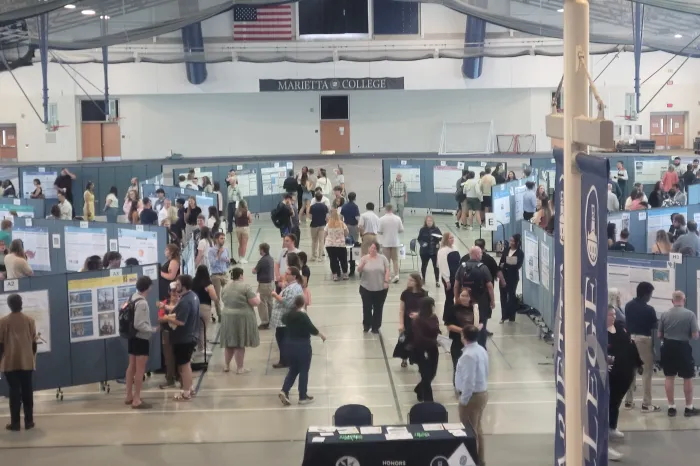
The day unfolded across campus in a steady flow of oral and poster presentations, performances, and conversations as students shared their work representing more than 15 fields of study. Classrooms, labs, and the Dyson Baudo Recreation Center became sites for engagement, where ideas were explored in real time. The Chemistry and Biochemistry sessions, held in the morning, drew strong attendance, including many alumni, with turnout nearly exceeding available space. These moments highlighted the scale of student learning and the continuous exchange of knowledge taking place throughout the campus community.
Students presented capstone research, class projects, internship experiences, study abroad reflections, and other Landmark Experiences that demonstrate how they tackle complex, real-world challenges. Topics ranged from public health and environmental science to communication and musical theatre, among others, affirming not only subject expertise but also the ability to articulate ideas effectively and engage varied audiences in professional and academic settings.
STEM projects showcased students working through challenges in biology, health science, and petroleum engineering. In these presentations, students demonstrated not only technical knowledge but also the ability to research, analyze data, and interpret results in practical ways.
In a Biology and Health Science Capstone oral presentation, Max King ’26 examined the effects of PLA and PTFE microplastics on embryonic development, using chickens as a model organism. Inspired by a peer’s prior research and growing interest in both industrial pollutants and emerging materials, King’s work explored how environmental contaminants may influence early limb, heart, and eye development, bringing together environmental science and biological systems to better understand potential health impacts.
“All of my research pointed to some pretty serious effects when developing embryos are exposed to these microplastics. Effects ranged from reduced cognition and stress-like effects to major malformations of the spine and limbs,” King said. “I think it should push people to think more about the pollutants they and their communities are exposed to—and use their voice to advocate for safer, less polluted environments.”
Creative and performance-based projects highlighted the role of artistic expression and technical design in student scholarship. Students interpreted ideas, built narratives, and brought original work to life through music, theatre, and art. These presentations underscored process and production, demonstrating the range of skills involved in fine arts disciplines.
In a Music Capstone: Jazz & Rock oral presentation, Cole McIntyre ’26 shared “My Writing Process for Blue Ice: Recorded with the Rock and Jazz Ensemble.” McIntyre traced the development of his original piece from a simple, rhythmic vocal hook into a fully arranged composition, shaped through experimentation with lyrics, chord progressions, and production. His work revealed how experimentation and refinement shape a piece into something distinct and fully realized.
“This project taught me that it’s not about what you write, it’s about what you do with what you write,” McIntyre said. “A lot of music is based on very simple ideas, but through arrangement and production, you can make it truly artistic and unique to you.”
In a Musical Theatre Capstone presentation, Brendon Thompson ’26 shared his lighting design work for the production “The Wolves.” Thompson aimed to create a realistic indoor soccer facility through color, focus, and intensity. Using a stark, harsh white lighting palette with minimal shadow, his work supported realism and audience immersion. He also addressed technical challenges, including adjusting lighting angles and distance to effectively light the cyc from behind, demonstrating precision and adaptability in live theatre production.
“This capstone helped prepare me to build on my experience in lighting and electrical work for theatrical purposes and related fields. I’m able to tell a story alongside other design elements, the director’s vision, and the story itself,” Thompson said. “The process helped me grow as an artistic creator, designer, and storyteller through visual imagery. Because of this capstone, I feel confident in continuing to build on my experience within the field.”
Additional campus spaces further showcased student innovation and hands-on learning. The campus Makerspace featured student-built technologies and 3D printing projects, while the annual Student Art Exhibition Reception and Awards celebrated work across mediums, reinforcing the role of artistic expression within the liberal arts.
Poster presentations displayed in the Dyson Baudo Recreation Center featured internships, study abroad experiences, service projects, and independent research across disciplines, including education, psychology, communication, health sciences, and additional fields of study. Many projects reflected direct community engagement, such as partnerships with local organizations, applied public health research, and internships that provided students with real-world professional experience. Attendees also voted for Best Poster, with Matthew Siegler ‘26 earning top honors for his poster, “The Cognitive Effects of Creatine Monohydrate on Mice.”
Olivia Emery ’28 presented on her internship with the Marietta City School District, where she worked alongside the district’s communications director to cover events and share narratives with the broader community. Emery conducted interviews with students, faculty, and staff and produced news-style content for the district’s publications. Her work reinforced the role of storytelling in shaping public perception while strengthening her ability to ask thoughtful questions, connect with sources, and communicate effectively with diverse audiences.
“I’ve always been interested in writing, and I think it’s meaningful to tell stories that people can connect with,” Emery said. “In a school district setting, that means communicating clearly with parents and the community, helping to shape the way people feel about the district and how it’s operating.”
Faith Schanks ’28 presented “Finding Agency Within Negative Stereotypes in Appalachia,” drawing from both academic research and personal experience. Schanks examined how persistent stereotypes inform perceptions of Appalachia, while highlighting historical figures and lived realities that challenge those narratives. Her work emphasized the importance of understanding context and recognizing individual agency within social and economic systems.
“I’ve always been surrounded by negative stereotypes about where I’m from,” Schanks said. “This project allowed me to explore what’s really happening in Appalachia and understand how Appalachians are affected by the system of where they’re from. Most importantly, recognizing that you have agency within your own life and choice is the most powerful thing you can do.”
Connor Rothandler ’26 shared his experience in the IES Study Abroad Program with the Universidad San Francisco de Quito in Ecuador, where he explored the Amazon Rainforest and the Galápagos Islands. Driven by a long-standing interest in travel, wildlife, and conservation, Rothandler chose Ecuador for its rich biodiversity and the opportunity to study environmental issues firsthand. His studies offered a deeper understanding of the impact of human activity on natural ecosystems, as well as the cultural and environmental complexities Indigenous communities face.
“Study abroad allowed me to experience a place that is being affected by human encroachment and deforestation,” said Rothandler. “I got to see firsthand how Indigenous communities are impacted. It also helped me find resilience and a deeper understanding of others, even though I faced communication challenges as I’m not fluent in Spanish.”
All Scholars Day is more than an annual event. It reflects an institution rooted in curiosity, collaboration, and the pursuit of purpose. Throughout the day, students engaged with peers, raised questions, and gained new perspectives, strengthening their growth as young professionals. For many seniors, the experience serves as a culmination of years of study, research, and mentorship. For underclassmen, it offers a glimpse of what’s ahead and what’s possible in their own academic journeys. At Marietta College, learning is not confined to the classroom. It is lived, tested, and shared. On All Scholars Day, that work takes center stage.