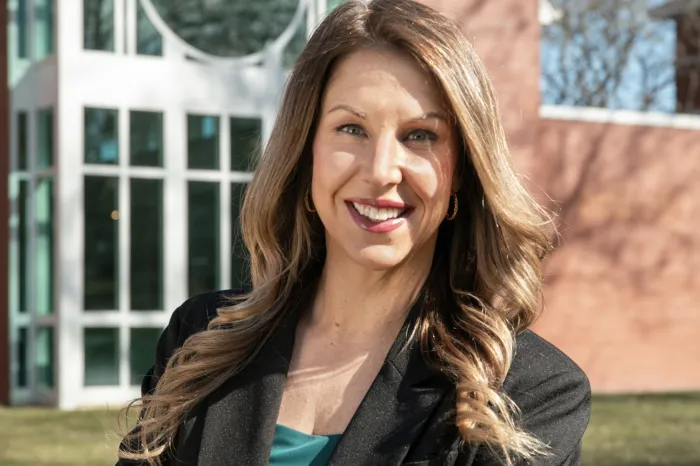
Lauren Thompson ’07 Returns to Campus to Share Groundbreaking Civil War Research
For Dr. Lauren Thompson ’07, Marietta College has always been more than where she earned her degree. It is where she found mentors who believed in her, formed friendships that continue to shape her life, and developed an academic curiosity that ultimately led her to become a historian.
Now an associate professor of American History at McKendree University, Thompson returned to Marietta’s campus on Wednesday, March 25, to share the research that has shaped her career. Her public lecture, “Friendly Enemies: Soldier Fraternization throughout the American Civil War,” drew from her book of the same title and explored the unexpected moments when Union and Confederate soldiers met during breaks in fighting to talk, trade food and tobacco, and interact across enemy lines.
For Thompson, the return to Marietta was deeply personal.
“That little town by the river holds a piece of my heart,” she said. “Anytime I can come back to see the faculty and staff, it means so much. It also feels good to give something back to the place that gave me so much by sharing not just my research but my story with current students.”
A Marietta Beginning
Her path to Marietta College began with a phone call.
As a first-year student at the University of Pittsburgh, Thompson quickly realized the large university setting did not offer the connection and personalized learning environment she was seeking. She began looking into smaller schools, and one day received a phone call from Dr. Jim O’Donnell, a Marietta College professor who would later become her advisor.
“He told me, ‘You can be in my class in the spring, and I’ll be your advisor,’” Thompson recalled. “At Pitt, I was taught by professors who felt unreachable, so I felt like a small fish navigating a big, challenging sea. At Marietta, I found the support and mentorship I really needed. This is also why I teach at a smaller arts school — I wanted to be that support for others, because I loved that connection with faculty members.”
The change proved transformative.
Thompson immersed herself in campus life, serving in Student Government Association (SGA) and eventually becoming student body president during her senior year. She joined clubs such as Model UN and College Democrats, sat on faculty committees, and built friendships with students from all corners of campus. Thompson, alongside several friends, also participated in orientation and peer leadership opportunities.
“I just fell in love with Marietta and dove in,” she said. “Leadership came naturally to me, but I also feel like we had those opportunities in place and that this is what we do here. I saw leadership from upperclassmen and realized that I wanted to be like that.”
Thompson looks back fondly on the opportunities she embraced and the friendships she formed at Marietta, from Doo Dah Day and Model UN trips to athletic events, spring break travel and memories of sled riding on campus. She described it as the best time of her life, an experience that made her want to stay in the college environment long-term.
Academically, Thompson discovered that her curiosity extended well beyond her history major. Courses in geology, communications, environmental law, literature, and gender studies all left a lasting impression.
“I loved all my classes. I never felt like there were just ‘gen ed classes’ and then ‘major classes,’ or that one was more important than another,” she said. “I loved learning in other courses and from the faculty across fields. That’s one of the things that makes a liberal arts education so valuable.”
Teaching with Purpose
The relationships she built with faculty also shaped her future career. Professors such as Matt Young and Katy McDaniel encouraged her intellectual curiosity and deepened her interest in history. Today, as a professor herself, Thompson often reflects on those experiences in her own teaching. For the past 9 years, Thompson has taught American History at McKendree University in Illinois. In the classroom, she emphasizes helping students think critically rather than telling them what conclusions to draw.
“I think of my students as a garden,” she said. “My job is to plant seeds — ideas, sources, questions. What they grow from that is their own process. They tend to their own gardens.”
Thompson sets up her courses so students can see the connections between historical events and the human experience, including issues of race, class, and gender. She encourages them to explore these topics independently, allowing their interests to develop naturally over time. Her goal is for students not only to gain historical knowledge, but also to develop a deeper understanding of themselves, the world, and the kind of people they want to be. In the process, they develop skills in her classroom, including empathy and critical thinking, that carry into any career or community. Thompson also incorporates primary sources into her courses, giving students opportunities to engage directly with historical evidence. Field experiences and interactive learning activities further support that approach, helping them connect the past to the present.
Her dedication to teaching has earned recognition from her university, including the 2025 United Methodist Exemplary Faculty Award and the 2025 William Norman Grandy Faculty of the Year Award.
Understanding the Human Side of the Civil War
After graduating from Marietta in 2007, Thompson pursued a master’s degree at West Virginia University. During the summers, she worked as a seasonal park ranger at Fredericksburg & Spotsylvania National Military Park in Virginia. Her advisor at WVU, the late Dr. Peter Carmichael, encouraged her to begin exploring a thesis topic that remains underexplored but offered rich possibilities for research. It was during this time that an unexpected discovery sparked the research that would become her book.
One evening while closing the Chancellorsville visitor center, Thompson stopped to read a small exhibit titled “Friendly Enemies.” The display described moments of fraternization during the Civil War, when opposing soldiers, despite strict military orders forbidding it, crossed lines to talk, exchange goods, and interact in small but meaningful ways.
The idea immediately captured her attention.
“We call it the Civil War, but it was not civil. It’s an oxymoron,” Thompson said. “How can, amidst the biggest war we’ve ever seen in US History, can men be slaughtering each other, then call a timeout and act like friends? It’s intriguing to figure out why and how this happened.”
The question became the focus of her research. It was also an accessible topic, as soldiers regularly wrote about their experiences in letters and diaries. Many of these accounts have been preserved in archives across the country. Though the research process was tedious and costly, it was easy for Thompson to access that data.
Drawing from hundreds of letters and diaries, Thompson examined these moments of fraternization and the reasons behind them. Many of the men involved were often labeled as reckless or undisciplined soldiers because these interactions broke military orders, even though some were highly decorated for bravery and remained dedicated to their units.
One example that stood out during her research was the story of Private Morris Brown. After helping capture Confederate soldiers and a Confederate flag at Gettysburg, an act that earned him the Medal of Honor, Brown was documented months later sharing coffee and conversation with a Confederate soldier. Stories like Brown’s challenged long-standing assumptions about what historians once considered “good” or “bad” soldiers. Thompson noted that hundreds of similar stories highlighted soldiers who were steadfast and loyal to their cause while still engaging with the opposing side.
“My research showed that dedicated soldiers sometimes broke rules, tested boundaries, and challenged military authority in order to survive or navigate the realities of war,” Thompson said. “We can’t just say because they fraternized, they’re not worth studying.”
For Thompson, these interactions reveal something essential about human nature. At its most basic level, soldiers were motivated by the same needs that shape human behavior in any crisis: safety, food, warmth, and survival.
She emphasizes that these moments were not simply moments of empathy. In many cases, they were rooted in self-preservation, with soldiers willing to use whatever means necessary to endure the conditions of war. At the same time, a sense of common humanity often emerged. Many of the men recognized similarities in one another such as background, language, religious practices, and age, which fostered mutual understanding.
“They were just trying to make it through the day,” she said. “Sometimes that meant recognizing the humanity of the person on the other side.”
Thompson’s research also highlights important complexities of these interactions. While white Union and Confederate soldiers sometimes fraternized, African American soldiers were largely excluded. Confederate troops often targeted Black soldiers more aggressively, viewing them as symbols of emancipation and a changing social order. Black soldiers also faced unequal treatment within Union ranks, where support for their service did not always extend to full equality.
Thompson noted that these patterns reflected broader divisions that would continue long after the war. Reunion narratives between former Union and Confederate soldiers often celebrated shared battlefield experiences while minimizing or ignoring the role of race and the fight over slavery. Thompson believes that understanding those contradictions is essential to studying the war honestly.
A Long-Awaited Return
Although Thompson’s book “Friendly Enemies” was published in 2020 by the University of Nebraska Press, the COVID-19 pandemic prevented the traditional book tours and public talks that often follow a major publication. Her lecture at Marietta College had therefore been several years in the making.
“There were bigger things happening in the world at that time,” she said with a laugh. “This visit has been long overdue. I am excited, and glad I waited to come do this talk with the Marietta family when the time was right.”
For Thompson, the visit to Marietta represented both a professional milestone and a personal homecoming.
During her visit, Thompson met with history students for an informal discussion where they learned about her approach to her topic and teaching, careers in history, and the many paths available to graduates with liberal arts degrees. She acknowledged that her own career path might not include traditional alumni advantages such as internships or corporate sponsorships, but she emphasized the lasting value of a liberal arts education and the personal fulfillment that comes from lifelong learning. She hopes her story helped students see that passion and purpose can lead to meaningful careers, even when the path is not always obvious.
“I think a lot of people don’t know what they’d do with a history degree, but hopefully I can ease their concerns by sharing where my recent McKendree grads are currently thriving. Some are working in law, some in government. I hope I can show Marietta students the unlimited possibilities and let them know they’ll be okay,” Thompson said. “Answering any questions they have about my path or my friends’ paths. I just want to reassure them that they’re in the right place; there’s a lot they can do.
Thompson also encouraged students to trust their interests, reminding them that Marietta provides a supportive environment to explore those pursuits. She emphasized that students are not alone in their ambitions and that the College offers opportunities to discover what truly calls to them.
Thompson is currently working on her next book, which examines race and recreation in Civil Rights Era St. Louis, Missouri. The project marks a transition into a new field, which excites her. She is drawn to social justice-oriented topics and feels this work aligns with her perspective and goals at this stage of her career.
Thompson presented her public lecture, “Friendly Enemies: Soldier Fraternization throughout the American Civil War,” at 7 p.m. Wednesday, March 25, in McDonough Auditorium on the Marietta College campus.