For more than eight decades, the Haessly family has lived the story of timber in Appalachian Ohio — from supplying lumber during World War II to navigating economic downturns and evolving markets that reshaped the industry. Through it all, the Haessly Hardwood Lumber Company has endured, guided by a commitment to hard work, responsible harvesting, and resilience.
Now, as new generations confront new challenges, business owner Jack Haessly sees an opportunity to help others learn from his family’s history.
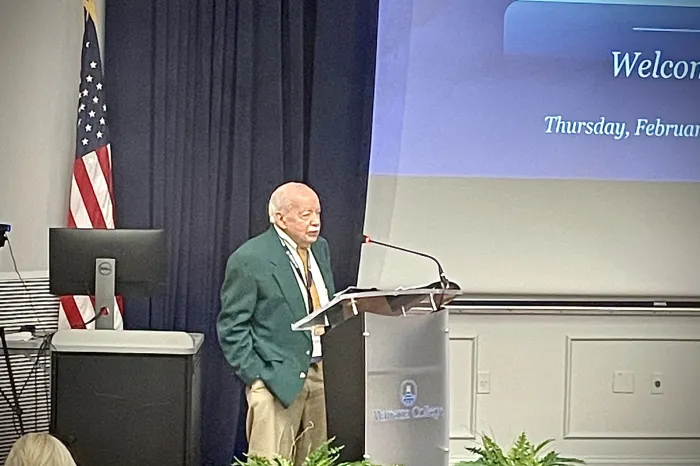
Standing before industry leaders, government officials, researchers, students, alumni, and community members Thursday morning at Marietta College, Haessly reflected on lessons passed down from his father, Norman, who founded the family business.
He remembered the uncertainty of past downturns and the determination that carried them forward. “Whatever it takes… we’ll get up earlier; we’ll work longer,” Jack Haessly recalled his father saying during the 1960s market downturn.
That mindset — equal parts grit and adaptability — set the tone for the Center for Appalachian Innovation’s inaugural Symposium at Marietta College, which focused on the future of the Appalachian Ohio timber industry.
“I was greatly surprised that the College took on this task and zeroed in on the Appalachian area and those of us who work in the lumber business are very pleased and appreciative of this move that the Center is making,” Jack Haessly said. “I hope we, as an industry, can contribute information and ideas that will be helpful to the Center’s mission.”
His family’s experience served as a powerful example of stewardship and innovation in one of Ohio’s most vital industries. Timber contributes $30 billion annually to Ohio’s economy — one-fourth of the state’s agricultural economy — according to the Ohio Forestry Association.
Spearheaded by Symposium Director Ann Nicely and Academic Program Director Michelle Jeitler, the event brought together voices from private, public, and government sectors, united in advancing one of Ohio’s most significant natural resource industries.
“This symposium represents exactly what the Center for Appalachian Innovation was created to do: Bring together expertise, research, and lived experience,” Nicely said. “We are incredibly grateful to the planners, speakers, and industry leaders who shared their time and expertise, and especially to the community members who attended because they want to learn more and offer their insight. Their participation ensures that the work we do reflects the real needs and opportunities of Appalachian Ohio.”
Keynote speaker Jenna Reese, Executive Director of the Ohio Forestry Association, opened Session I with a look at the state of the Appalachian Ohio timber economy and emerging opportunities.
“This is a really exciting opportunity for us,” Reese said. “As we talked about earlier, 66 percent of our forest resource is in Appalachia; and unfortunately, it’s the state’s best kept secret. The platform that the Center for Appalachian Innovation provides will allow us to tell that story broadly and often. I’m encouraged that the College recognized the importance of the timber industry and that the Center is helping highlight it by bringing together experts and industry leaders. We’re really looking forward to the work that comes from it and the partnerships it creates.”
Panels explored emerging markets, manufacturing innovation, and regional economic development, highlighting timber’s role in renewable energy, construction, and sustainable growth.
For Marietta College students, the symposium provided an opportunity to connect academic learning with real-world challenges.
“I didn’t know much about this region until I came to school here, so it’s interesting to me to learn more. I was kind of surprised to hear about how much the timber industry really matters to this state,” said Wyatt Stapleton ’29, a Health Science major from Warsaw, Indiana.
Alumni also returned, including Michael R. Moran ’90.
“I came back for three reasons: One, I want to support Marietta College; Two: I want to support the Appalachian region with economic development opportunities and feel strongly about that, due to the work I do with tax credits; and third, because I have been a rural landowner and owned a family forest in rural southeast Ohio and I'm interested in the timber industry, which is an extremely important industry to Ohio; I wanted to support the timber industry and learn more from the experts who are here.”
For Jeitler, student involvement remains central to the Center’s mission.
“One of the most exciting aspects of this symposium is how it opens the door for Marietta College students to engage directly in research that matters to this region,” Jeitler said. “By involving students in studying emerging timber markets, sustainability practices, and economic development, we are helping them develop meaningful research skills while also contributing knowledge that can strengthen Appalachian Ohio’s future.”
The symposium also reflected the broader mission of the Center for Appalachian Innovation, launched last fall to foster research, dialogue, and regional engagement.
“The Center for Appalachian Innovation is possible because our state legislators chose to believe in us and what we can deliver for our community, for our region, and for Appalachian Ohio,” said Marietta College President Kathleen Poorman Dougherty. “In doing so, they made an investment and provided the capacity for us to address regional opportunities together, to allow our students to become versed in the persistent challenges facing the Appalachian region and assuring that we will turn out graduates ready to engage, armed with relevant information, and prepared to contribute productively. The intention is that this Center will allow us to learn together, to foster productive and constructive dialogue, and to support research that will further the interests of our region.”