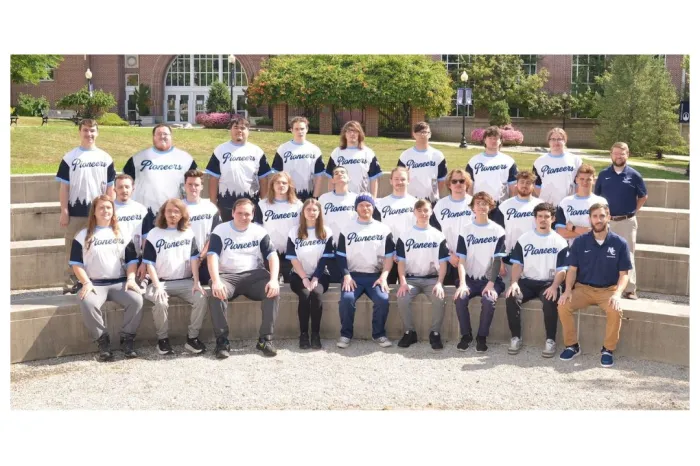
Keyboards clicked late into the night. The glow of monitors reflected in focused eyes as nerves ran high and players prepared to take their skills to the next level. This fall was a milestone season for Marietta College Esports, marked by breakthrough competitive and educational opportunities. For the first time, multiple teams traveled to two major LAN tournaments, giving players a chance to connect, compete, and grow together in ways that the program had never experienced before. It was a semester defined not just by wins and losses, but by opportunities to travel, lead, learn and experience the camaraderie that makes a team more than a roster of players.
The momentum extended beyond tournaments. Weekly team meetings transformed into professional learning sessions, as industry leaders, coaches, content creators, marketers, and project managers joined students virtually to discuss real careers in the esports industry. Players asked questions, explored new career paths, and began to understand that success is not limited to gameplay. Head Coach Derek Games noted that the expanded speaker series set a new standard for the program, opening doors for every student involved.
Speakers included former professional Overwatch League player and current caster for the Marvel Rivals Ignite League, Dustin “Dogman” Bowerman; Liquid Media social media manager Jesse Goodman; Aftershock Media project manager Michael Schwartz; and former FlyQuest marketing manager Angeline Phan.
“One main takeaway from the expanded speaker series was how important networking is, because Marietta College focuses on building connections,” said Zach Simpkins ’27, captain of Overwatch 2 and Rainbow Six Siege. “I got to hear from individuals who are where I want to be after graduation.”
Marietta College Esports has eight game rosters, including Fortnite, League of Legends, Marvel Rivals, Overwatch 2, Rainbow Six Siege, Rocket League, Super Smash Bros, and Valorant. With a roster of more than 25 players this season, the program is building depth, structure and leadership across each team.
The League of Legends team delivered its strongest season to date, finishing 4-4 with a young lineup that exceeded expectations. Their teamwork, communication, and confidence took major strides, laying a solid foundation for future success. Freshman Ian Layman ’29 said this year’s League team showed genuine growth, noting that the team’s late-season win streak demonstrated a new level of trust and cohesion. Coach Games echoed his sentiments, saying that League of Legends had its best competitive season since the program’s inception.
“I was really happy with how our League of Legends team did,” said Layman. “From what I’ve heard, this is a good season for League of Legends. I’m excited to see what we can do moving forward.”
Overwatch 2 and Rainbow Six Siege also pushed the program forward, competing alongside more established programs at major regional events.
“For Rainbow Six Siege, we now hold our record for most wins at a LAN event,” said Simpkins. “We played against schools like Penn State University’s Blue Team and Rochester Institute of Technology. Winning twice and losing twice at Battle for PA was a significant benchmark.”
The team traveled more than 1,000 miles throughout the season, competing at two major LAN events. The two tournaments—Battle for PA at Lackawanna College in Scranton, Pennsylvania and Midwest Esports Conference Clash in Chicago, Illinois—allowed the players to compete at a higher level, representing Marietta across the region. Layman noted that being invited to a LAN event in Chicago isn’t the norm for Marietta Esports, an opportunity that proves the team’s visibility is quickly rising. Simpkins added that the program typically attends one LAN event per semester, so sending multiple teams to two marked a new achievement for the program. Invitations came to them, a sign that the region is beginning to take notice.
These opportunities have expanded the program’s visibility both on campus and throughout the region. Simpkins noted that increased travel and social media presence are helping Marietta Esports operate more like traditional athletic teams, with greater reach.
On the road, the team became a family. New players who walked into practice in August, unsure of where they fit, were laughing with veteran players by September, forging lasting bonds. Shared meals and moments, such as a first-time Mongolian hot pot dinner in Chicago, helped the group learn more about each other than long hours of practice ever could.
“It’s always interesting to see the new players come in on week one and be intimidated, not knowing where they’re going to fit in the system. By week three or four, they’re fully ingrained into the program and their specific team,” said Coach Games. “They form friendships and develop camaraderie more quickly. It’s nice to see groups of teams on campus together.”
Reflecting on the growth of his League of Legends team, Layman noted: “We started out very disjointed, but by the end of the season, we went on a decent win streak, building confidence in each other.” He added that many members of the League of Legends team hadn’t been part of any form of team before, and while it slowed them down early on, it helped the members find each other and build skills.
Bonding moments defined their season. Players crammed into vans for long drives, navigated a model train expo in Scranton, and even ended up singing together in a hotel pool late one night. Layman noted that the League of Legends team slept in the same hotel room, with some players sleeping on the floor, although there was extra space in other rooms—a choice the students made to foster team bonding. These moments became stories they’ll carry long after the season ends.
“We always see a very different side of the students when traveling versus day-to-day,” explained Coach Games. “It’s really interesting. They open up more and become more relaxed.”
For Simpkins and the Overwatch 2 team, friendships were central and built through shared challenges. He said the team often eats dinner together on and off campus, usually ending the night gaming in the Esports room with Kitchen Nightmares playing in the background.
Team captains carried dual responsibilities, supporting Coach Games with logistical duties while leading in-game strategies. Their leadership guided decision-making, coordination and team morale, setting the tone for younger players.
This semester strengthened the program’s “Three C’s”—culture, competition and career development—while exploring innovative ways to build audiences and generate revenue. Players tested streaming capabilities through a 24-hour Day of Giving volunteer fundraiser. Simpkins said the event was a fun way to gain support while showcasing their gameplay, and that the team hopes to host another in the spring. In November, the program also collaborated with Marietta’s Rock and Jazz Ensemble, hosting The Music of Minecraft (and other selections), blending live gameplay with campus arts in a first-of-its-kind collaborative event.
In addition, plans for spring include an Admissions event, inviting local high school programs to watch the team play live, expanding community engagement and recruitment. Scholarship tryouts continue to open the door for high school seniors ready to commit to competitive gaming at the collegiate level.
This semester also marked a turning point for the program’s long-term trajectory. With stronger coaching support and rising competitive results, Marietta Esports is establishing itself as a program on the rise.
“Having a League of Legends team this year was a big accomplishment,” said Simpkins. “We have two alumni coaches who are very hands-on. Rainbow Six Siege continues to punch above its weight, competing with D1 schools like Bowling Green and international opponents such as Puerto Rico.”
Even with only three of eight game rosters active this fall, the program continues working toward full roster capacity, a challenge that requires consistent recruitment and player development. Coach Games sees this semester as a new benchmark, a reminder that Marietta Esports is still climbing and defining what success looks like for the growing program.
“It’s always a setting of a new standard. Always giving a new challenge to complete, a new bar to clear,” said Coach Games. “Trying to find ways to improve on what we did and offered, and weave in new things while keeping what works and maintaining our identity throughout.”
As the fall semester ends, Marietta Esports is preparing for what’s ahead. Tournament invitations, new travel opportunities, stronger rosters, and more chances for student leadership are leveling up the program for spring. The miles they traveled this semester weren’t just physical; they marked the growth of a program and a community. For these players, this is only the beginning of the legacy they’re building together.