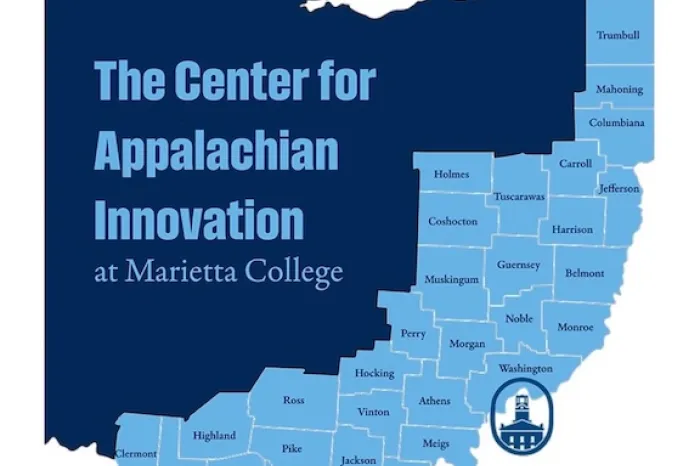
Like the forests that shape the Appalachian landscape, Marietta College is deeply rooted in this region — its people, its history, and its future. From those roots grow new ideas and leaders committed to strengthening Appalachia. That connection comes into focus through the Center for Appalachian Innovation (CAI), which invites alumni, the community, industry and government to help cultivate what’s next for the region, beginning with its inaugural symposium, The Future of Appalachian Ohio’s Timber Industry, on February 26.
Featuring keynote speaker Jenna Reese, Executive Director of the Ohio Forestry Association, the symposium includes sessions on the state of the Appalachian Ohio timber economy, emerging markets for timber, defining and executing on development opportunities, and public-private partnerships. The symposium reflects Marietta College’s commitment to applied learning, regional leadership, and More History to Make in Appalachia.
The work behind the symposium —and the Center itself — is grounded in a clear mission: “The Center for Appalachian Innovation at Marietta College will support our region through research, opportunities for engagement, and outreach. It will establish Marietta College as a thought leader in the region, a partner in innovation, and a driver of economic growth.”
That mission comes to life through faculty- and student-led research, capacity-building support for local and regional governments and small businesses, and convenings like the timber symposium that spotlight opportunities across the region. The Center is co-led by Michelle Jeitler, Academic Program Director for CAI, and Ann Foraker Nicely ’03, MCM’05, Assistant Professor of Communication and Symposium Coordinator.
Hailing from Cambridge, Ohio, Chase Stephen ’28 understands and cares about the Appalachian community. This semester, the Mathematics and Chemistry major is using his data and research skills to potentially help improve the lives of his neighbors.
Stephen is among a group of students taking DATA 410, a project-based course taught by Jeitler that is examining Opportunity Zones to help create economic opportunities for the Appalachian Region. There are also four CAI interns who are working on a project with Dr. Greg Delemeester, McCoy Professor of Economics, and Jeitler that focuses on the Economics of Health Care in Appalachia.
“The CAI Fellows are students who are working on regionally specific Appalachian problems and their research will be used to generate white papers. These are documents that the state legislators, county commissioners and leaders in our region can read. And so our four students right now are working on the Economics of Health Care in Appalachia to see if there's been a decrease in the number of specialists and then what is the overall economic impact to the community,” Jeitler said.
She emphasized that “community” means more than tax bases or provider counts. “Not the ‘tax- paying specialists’ being the community, but the community as in people having to take time off work now to go to Cleveland or Columbus or Cincinnati in order to get specialist care. And so what is the cost of that? Because now they're having to take a day off work, they're having to drive, and so forth.”
Through CAI, students also participate in paid internships with organizations across Appalachia, from public health agencies to private businesses, with the goal of encouraging graduates to stay in the region and help address its most pressing challenges.
For Nicely, each symposium is intentionally designed. “For each symposium, such as the timber, there is always going to be a purpose and a rationale for why that particular topic was chosen. For example, understanding why the timber industry was selected and what impact it has on the Appalachian community. On top of that, there will always be objectives. So if we select healthcare for the fall symposium, there will be core objectives.”
Students say the experience is already shaping how they see their education—and their impact.
“For our DATA 410 class, we are working with Sunday Creek Horizons to help advocate for census tracts in Appalachian Ohio to become opportunity zones, said Austin Ziance ’27, an Actuarial Science major. This course has already impacted me by allowing me to showcase my knowledge and abilities… to tackle a real-world problem.”
Emma Cozza ’28, an Actuarial Science major with a minor in Finance, said the class focuses on Opportunity Zones in the Appalachian Region of Ohio, specifically examining both quantitative and qualitative data to determine which census tracts need an economic boost and have investment opportunities.
“The overall goal for this class is to create a solid list of tracts that we think should be Opportunity Zones that we could bring to our legislation to possibly get approved,” Cozza said. “This course has not only taught me valuable hard skills that I will use in my future, but also soft skills. For example, teamwork and communication are crucial parts of this course, as well as critical thinking and problem solving.”
For alumni, CAI offers a new way to stay connected to Marietta College and Appalachia. Jeitler believes that connection is natural. Alumni can attend symposia, engage with student research, network with regional leaders, and see firsthand how Marietta College is partnering for progress in Appalachia. “I think alumni will appreciate just getting involved and seeing what we're doing and being inspired by it because it's really inspiring,” Jeitler said.